The Silvering

1
Arthur Wren had stopped looking at himself in mirrors around the time other people stopped looking at him. He placed that somewhere in his early sixties, well before Maggie got sick. So he could not blame it on the grief. It was an arrangement that suited everyone. He shaved by feel, combed his hair with his fingers, and let the man in the mirror get on with whatever the man in the mirror did all day.
So he could not have said why, on a Tuesday evening in a March that behaved like January, he was standing in the bathroom of the house in Walthamstow with his hands on the cold edge of the sink, looking.
The radio was still going downstairs. He left it on for the same reason he left lights on. Not company, exactly. Ballast. A measured voice was saying that talks had broken down again, that markets were responding, that a response was expected to the response. Arthur had spent forty years as an internal auditor, and an auditor learns one question before all the others: is the control actually controlling? He understood, the way you understand weather, that the voice on the radio was describing a world where nobody could answer that question anymore. Nobody knew which controls still held. Worse, he found he could not care. That frightened him more than the news did, on the evenings when anything could.
They had bought the house in 1989. The street still had a butcher then, and you could believe, if you kept your working papers in order, that the world was a system somebody somewhere was reconciling. The butcher was a phone store now, and the phone store was closed, and the people on the street were younger than his shoes and lived behind doorbells with cameras in them. None of that was anyone's fault. It was only that Arthur had spent his whole life testing the controls of a system that had been quietly retired, and nobody had thought to tell the last man still running the tests.
The man in the mirror had white stubble and Maggie's reading glasses pushed up on his head. His own were always elsewhere. Hers were always exactly where she had left them. That was the whole difference between them, preserved in eyewear.
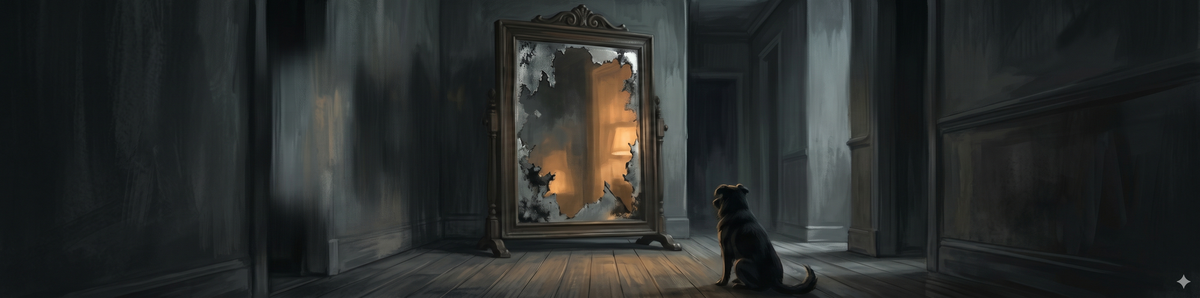
Behind the man in the mirror, the bathroom door stood open onto the dark landing, the way he always left it so Maya could push in and out. Maya was lying across the threshold now with her chin on her paws. One brown eye shut. One blue eye half open and aimed at him, on duty even in her sleep. Maggie had chosen her, seven years ago, from a litter in a kitchen in Kent, and had carried her home on her lap saying that a dog with one blue eye could see the wind. It was nonsense. Maggie had known it was nonsense. She said it the way she said all her nonsense, daring the world to be duller than she was prepared to let it be.
Something moved behind the door.
Not in the bathroom. In the mirror. A shape crossed the dark of the reflected landing, left to right, the height of a person and gone before it finished being anything, the way a fish is gone before the water closes.
Arthur stood very still. In the mirror, the landing lay dark and empty. On the threshold, Maya's head came up, both eyes open now. She was not looking at the landing behind her. She was looking at the mirror.
"That's us," he told her. His voice sounded like a man asking a question. "There's nobody."
He searched the house anyway. He was a methodical man, and fear files itself under method better than anywhere else. Fear also does its best work through a closed door, so he opened every door in the house. He went room by room with the dog at his knee, turning on lights he would later have to turn off. The closets. The space under the stairs. The attic hatch on its cold aluminum ladder. He stood in the backyard in his slippers and looked at the shed, where his bicycle hung beside the empty hook. Her bicycle had hung there until he could not stand the pair of them. The freezer hummed in the back room. Her inventory list was still taped to the lid in her square handwriting. Soup x4, green beans, the bread you don't like. Fourteen months, and he had eaten none of it and crossed nothing off.
Nobody. Of course nobody. The front door was locked and the back door was locked, and Maya, who announced the mailman from two streets away, had heard nothing all evening. A tired man's eye, that was all. A floater. At his age you grew them like weeds.
He went back to the bathroom to prove it.
The landing behind him was dark, and the landing in the mirror was dark, and the man in the mirror looked like what he was. A sixty six year old auditor who had outlived the only system he had ever wanted to keep honest. He leaned closer, to inspect the eye that had betrayed him.
In the mirror, at the far end of the reflected landing, under the door of the bedroom he had not slept in for fourteen months, lay a strip of warm yellow light.
Arthur turned around so fast his hip caught the sink. The real landing was dark. The real bedroom door was shut on a dark room, as it was every night, as it would be forever. He turned back. In the mirror the light was still there. Patient. Domestic. The exact light of a bedside lamp on her side. And while he stood there not breathing, a shadow moved through it, the soft interruption of someone in a room, crossing between the lamp and the door.
Maya was beside him now, front paws on the sink cabinet, staring into the mirror with her head tilted at the angle she saved for things that were almost words. She was not growling. Her tail was moving, low and slow and uncertain. The wag of a dog hearing a familiar step too far away to swear to.
"Maya," Arthur said. "Down."
She did not get down. He reached past her to touch the cold mirror, to put his hand flat against the lie of it, the way you press a bruise to know the size of it.
His fingers went in to the second knuckle.
2
He took his hand out of the mirror the way you take your hand off a hot pan. By reflex, before the understanding arrives. Then he stood holding his own fingers and looking at them. They were pale and ordinary, and they smelled, very faintly, of warm dust. Like the linen closet when Maggie used to open it.
He should have called someone. He ran the list. His doctor, a kind hurried woman who would write down mirror, warm in her notes and refer him to someone with a softer voice. His brother, five years dead in Leeds. The men from the office, who had sent a card with a lighthouse on it. There was no entry in the list for this. Arthur had kept lists all his life, and he knew what it meant when a thing has no entry. The list is finished. Not the thing.
In the mirror, the strip of light still lay under the bedroom door. In his house, that door had been shut on a dark room for fourteen months. He slept in the spare room now, among the boxes he had packed and never driven to the donation center. He told himself it was because the spare room was warmer. Every night the telling worked a little less.
He did not decide. Deciding was what he had done all his life, with findings and sign-offs and other men's mistakes, and he knew what deciding felt like. This was not it. He leaned. The way a man standing on a riverbank in winter is not deciding anything, and then the bank is empty.
Maya went first.
She gathered herself off the sink cabinet and went through the mirror the way she went through the gap in the community garden hedge. Without ceremony. A brief liquid arrow of gray and black, and gone. The mirror did not ripple. It simply had a dog in front of it, and then did not.
That settled it, the way she had settled everything since the funeral. He could not leave the dog.
Climbing over a sink at sixty six is not a thing a man does with dignity. He got a knee in the bowl and his hip caught the faucet, and he heard himself say sorry, to the house perhaps, or to the man in the mirror who was not there anymore, because the mirror now showed only the bathroom and no Arthur in it at all. He shut his eyes and went through the way you go into cold water. All at once, owing the world a scream and not paying it.
There was no jolt. There was one long moment of the warm dust smell, and a feeling, gone before he could hold it, of a hand laid flat between his shoulder blades. Not pushing. Not steadying. Present, the way her hand used to be when he carried something heavy down the stairs.
Then tile under his slippers. The same bathroom. Not the same. Warmer, and the air had supper in it, onions cooked an hour ago, and the towels were folded in thirds on the rail. Maggie had always folded the towels in thirds. Arthur had spent fourteen months folding them in halves, because thirds was her method, and he would not commit forgery.
Behind him, the mirror held his own dark bathroom for a moment, held it the way a photograph holds a room. Then, like an eye closing without hurry, it was only a mirror, with an old man and a dog in it and a bright bathroom behind them.
He pressed his whole hand flat against it. Solid. He pressed both hands, then his knuckles, then his forehead, very gently, resting it there. Cold, certain, absolutely closed. His breath fogged it the way breath had fogged every mirror he had ever stood in front of, and the fog faded the way it always fades.
The panic rose, and he did with it what he had done for forty years on the nights an account would not reconcile. You did not shout. Shouting was for people who believed the world owed them an answer. You found the next fact.
The next fact was light under the bedroom door. Real now. Six steps away, across a landing he had crossed forty thousand times.
The fact after that came up the stairs to meet him, soft and unhurried, out of the kitchen where a kettle had just gone off the boil. A radio, talking low. The click of a cabinet he could have found blindfolded.
Footsteps, crossing the kitchen below.
He had been married to those footsteps for forty years. Beside him, pressed against his leg, Maya began to wag.
3
He did not go down at once. He stood at the top of the stairs with his hand on the banister, and the banister was warm where the radiator below it had been on all evening. In this house, somebody still heated rooms they were not standing in.
The landing was his landing. The wedding photograph hung where the wedding photograph hung. The same two young people outside the same city hall, his lapels a comedy, her smile exactly the smile. But the spare room door stood open, and the spare room was a spare room. Bed made flat and unslept in. No boxes. And on the dresser, propped against the lamp, where in any house in any world you put the things you cannot file and cannot throw away, there was a card with a dove on it.
He knew what it was before he picked it up, because the men from the office had sent him one with a lighthouse. He picked it up anyway.
The funeral program said Arthur James Wren, 1959 to 2025. It said In Loving Memory. Under the dove there was a hymn he would never have chosen, and a photograph of him squinting on a beach in Wales, taken by her, on a day he could name.
He sat down on the top stair. His legs did it for him. He was only informed.
Below, the radio murmured. The kettle was poured. A spoon went twice around a cup and was set down on the steel of the sink with the small bright tap of a thing done ten thousand times by the same wrist.
Arthur worked the problem methodically, because method was where fear filed itself. This was not his house. It was the house next door to his house, in some direction there was no name for. A house identical down to the limescale, except that here, fourteen months ago, the cancer had gone down a different corridor in the dark. Here it was Maggie who had come home alone from the crematorium in a black coat. Him, they had printed on a card.
He had wanted her back every hour of fourteen months. The wanting had been the structure of him, the way scaffolding becomes the building when the building is condemned. And here she was. Ten steps down and one room across, alive enough to pour a kettle. Arthur sat on the stairs of his own house in his slippers and understood, with the cold clarity he had spent a career being paid for, that she was not his.
Her grief was not his grief. Her fourteen months were not his. She had buried a husband with his face and his fingerprints and his bad hip, and whatever that man had been to her in his last private hours belonged to the two of them. One of the two of them was him in no way at all.
He went down anyway. He had to see her. He owed nothing and was owed nothing in this house, but he had to see her. He went down in his socks with his slippers in his hand, stepping over the fourth stair from the bottom, which creaked in every world, apparently, where there was an Arthur to learn it.
She was at the kitchen table. The gray braid lay over one shoulder of a cardigan he did not recognize. Blue. New. A thing bought by a woman dressing a life he was not in. Her second pair of reading glasses sat on her nose. She was filling in the freezer list in her square handwriting, and the radio was on low, and her tea steamed beside her wrist. One cup.
She was seventy and she was alive, and the lamplight sat on her hair, and Arthur Wren stood in the dark of his own hallway and did the cruelest piece of arithmetic of his life.
If he stepped into the light, the first thing he would be was a horror. A dead man in the kitchen doorway in his socks. Hearts have stopped for less, and hers had spent fourteen months learning to beat around a hole the exact shape of him. And if her heart held, if she screamed and then stopped screaming, what then? What he could offer her was a forgery hung in the place of a stolen painting. Correct in every brushstroke. Wrong in the one way that mattered. She would spend whatever years she had left trying not to look too closely, being kind to him, being so kind, the way you are kind to the thing you cannot afford to examine.
He would have her tea and her braid and her alive, breathing presence on the other side of a table for the rest of his life. And every morning her eyes would do a small quick thing before they settled, and he would learn that small quick thing the way he had learned the fourth stair, and it would kill them both, slowly and politely.
Beside him in the dark, Maya's claws clicked once on the hall tile.
Maggie went still.
She did not turn around. Her pen stopped on the list, and her head lifted a degree, and into the quiet kitchen of the house where her husband was fourteen months dead, in the voice she used for things she had stopped expecting answers from, she said,
"Arthur?"
He did not breathe. She did not turn. And he understood that she did not turn for the same reason he had never once moved her reading glasses off the hall shelf in his own world. The same reason he left the radio on. The same reason the freezer list stayed taped to the lid with nothing crossed off. As long as you do not look, the house can keep its other tenant. She was not asking the doorway. She was leaving a light on.
She picked her pen back up. The radio murmured to the both of them.
Arthur backed away down his own hall, one slow sock at a time, with his hand down at Maya's collar. The gift he left in that kitchen was the only one he had that was worth anything, and it was the costliest thing he had ever done. He left her his death, intact.
Upstairs, the bathroom mirror stayed solid, no matter how long he held his palm to it. Whatever the mirrors were, they opened forward and they never opened twice. He did not know that yet as a rule. He knew it as a closed door, the first of many. It was Maya who found the way on, in the spare room, at the old wardrobe with the full length mirror that had come from somebody's grandmother in every world it stood in. The silver behind the glass had gone thin at the edges, gray blooms creeping inward like frost on a window. Maya sat in front of it with her head tilted, and waited for him to catch up.
He looked back once from the wardrobe. At the landing. At the strip of lamplight reaching up the stairs from her kitchen. And the thought arrived that would carry him further and cost him more than any thought of his life.
If there was a world where she had buried him, then nothing was final. The books did not have to balance the way his had balanced. Somewhere, in an infinity of versions, there was one where nothing had been written off at all. Two old people arguing gently about bread. Arthur had spent forty years finding the entry that did not belong. He told himself a man could find the one that did.
He put his hand to the gray-blooming mirror, and it gave, and the air on the other side was cold.
4
He counted, of course. He had counted for a living.
World two was his house full of strangers' furniture and a child's bicycle in the hall. He stood in it like a burglar of nothing and left within the hour, through the dark screen of an unplugged television, which took him completely by surprise and taught him the second rule. It was never the mirror you would have chosen. World three he never understood at all. An empty version of his street where every front door stood open and rain fell up, fine as dust, from the sidewalks into a moving sky. He did not stay to learn its reasons.
World four was the war.
It was London, his London, down to the bones of it. But the city lay under blackout the way it had in his mother's stories, and searchlights stood up over the rooftops like pale rulers measuring the cloud. The sirens answered each other across the boroughs the way dogs do at night, each one setting off the next. He never saw a plane and never saw a fire. He saw lines. A line outside a church, a line outside a pharmacy, people standing in the cold with the patience of people who have stood in it before. Nobody asked anything of an old man with a dog. In worlds with sirens, nobody asks. He learned not to wonder what the war was about. In the dark cosmetics hall of a dead department store, among a hundred mirrors that held nothing but other mirrors, Maya walked the aisles with her nose up and sat down in front of exactly one, a tall floor mirror with the silver gone gray at its edges. That was the night he stopped doubting her and started following.
Where there were radios, every world was frightened. Each of something different. He could rarely learn what, and after a while he stopped trying. It steadied him, in a bitter sideways fashion. His own world had not been specially cursed. It had not failed some test the others passed. Home had only been home. One more country of worried voices doing their best.
In the drowned world the streets were canals the color of strong tea, and the traffic lights stood in the water with gulls nesting on them, changing for nobody. He poled himself along his own borough on a wooden door, with Maya lying flat and seasick and disgusted at the front of it. The houses stood open-windowed and patient in the water. Washing still hung between some of them, stiff and gray, like the flags of a country that had surrendered to nothing in particular. The mirror that gave was in a hair salon, on the second floor, above the brown waterline. A long mirror in front of a row of dryers. To reach it he had to stand the door on end in the silt and climb, and at the top, with his arms shaking, he laughed for the first time in two worlds. The last thing that mirror would ever reflect was an unshaven retiree mounting it out of a flood, and there was nobody anywhere to tell.
The kind world he never learned the name of, because he never learned a word of the language, which fell like dry pebbles, fast and small. It was a market town in hills. Sharp air, woodsmoke. Nobody stared at him, though his clothes were wrong in every dimension. A woman with flour to her elbows looked at the pair of them across her stall, the old man and the thin dog, and she did not ask anything in any language. She put down a tin dish and fed Maya first, watching her eat with her arms folded like a judge. Only when the dog had finished did she hand Arthur the flat warm bread. He tried thank you in the four languages he had audited in. None of them landed. She pressed a second bread into his coat pocket with floury fingers, touched Maya once on the head, between the mismatched eyes, and turned back to her stall, as if kindness were simply the next item on the list.
Arthur walked out of the market and stood behind a wall and wept. The first time in all of it. Not at the funeral. Not in the kitchen where his wife sat alive in the lamplight. Here, holding warm bread, in a world with no name. Nobody came to watch him do it, which he understood was a courtesy and not indifference. When it was done, he wiped his face and fed Maya half the second bread, and they went on.
There was a world of wind that never stopped, where he learned to walk leaning, and where he tied Maggie's reading glasses to his head with a bootlace, because the wind wanted them and he was not going to be the man who lost her glasses. There was a world where fine gray ash fell endlessly, softly, like patient snow, and the people were gone but their gardens were not. Cabbages, swelling calmly under an inch of gray. He never learned whether the ash was an ending or just weather. There was a world that was his street to the brick, except the houses had no numbers. Not a digit on a door the length of London. There were no birds. Maya would not stop shivering, and they left within the hour through the mirror of a barbershop in which, he noticed at the last moment, his reflection was very slightly too slow.
His beard came in white. His good hip went the way of the bad one. He lost count somewhere in the thirties. A man who had audited completeness for forty years, and he lost the count. That was the truest measure of those weeks. Truer than the boots he wore through.
And the hope shrank the way a fire shrinks. From the outside in. In the early worlds he had studied the backs of gray-haired women in lines, waiting for one of them to be carrying the braid. Then for a long stretch he stopped looking for her, and looked only for his own front door, his own year, the right trash cans. Home. By the time of the world with no birds, he had stopped looking for home, and was looking only, in each new place, for water clean enough that the dog could drink it.
He learned the feel of the mirrors that give. Old ones, mostly. Silver gone thin behind the glass, gray blooming inward from the edges like frost. A restorer had told Maggie once, about her grandmother's mirror, that the trade called it desilvering. Nothing to be done. Past a certain age, the silver simply gives up holding the world out. Arthur carried that sentence across thirty-odd worlds before he heard what it was actually saying.
Maya thinned. Her ribs came up under the merle like a fence under snow. She worked every world nose-down at his knee, and she never once failed him at a mirror, and he fed her first. Always. Before himself, every time, because a woman with flour on her arms had shown him the correct order of things, and it was the one piece of doctrine he had picked up in all the worlds that he knew to be sound.
It was himself he could not forgive. She had not leaned at any riverbank. She had followed him through a hole in the world because her whole law was that he was not to go anywhere alone, and she was paying for his hope in ribs.
"One more," he told her, in world after world, in lobbies and bedrooms and dead department stores, with his hand flat on the cold of the next mirror. "One more, girl."
And the worlds went on, the way the news had gone on, the way the radio voices had always said one more thing after the thing you could not bear. Somewhere far back down the chain, a kettle was poured in a lamplit kitchen by a woman who had not turned around. And ahead of him the silver went on giving up, world by world, letting the next thing through.
5
Then there was the coast.
He came through into the lobby of a white hotel gone gray, all gilt and dust sheets, and walked out between its propped-open doors onto a boardwalk where fruit trees had broken up through the planking and gone happily feral. The air was mild. Below the railing, a green sea moved like it was paid by the hour and liked the work.
There were no people. There had been people once, the hotel said so, the bandstand said so. But the doors all along the front stood open the way doors only stand where nobody is left to mind, and in three weeks he never found so much as a bone. The world was not ruined. It was vacated. Swept, returned in good order, deposit refunded. He stopped asking that question too.
They stayed. He had not meant to. He fixed his boots with an awl from the hotel workshop, and he learned the tide pools, and there were gulls' eggs and small sharp apples and a stream above the town that ran clean over brown stones. Maya drank from it every morning while he washed. She filled out, week by week. She took up her old war with the gulls. One evening she came down the beach to him at a dead run for no reason at all, ears flat, body low and joyful, carving circles in the wet sand around him the way she had at three years old, and Arthur stood in the long light and thought: we could be dead here very slowly, and it would look exactly like this.
That was not the thought that moved him on. The thought that moved him on came later, at the fire on the beach, when he heard himself telling Maggie about the gulls.
He had narrated his days to her for forty years and fourteen months. But by that fire he heard himself doing it. Heard the shape of it. A man alone on the shore of an empty world, explaining his day to the dark. He understood, with no drama at all, that staying meant only this: a roomier Walthamstow. The sea doing the radio's job, on better wages, saying its one measured thing over and over while he kept the gutters of his days clean and waited beside a freezer list nobody would ever cross off. The world was kind here, and empty, and her absence was not one ounce lighter for the mild air. He had not crossed thirty-odd worlds to find a more scenic place to be ending.
Maya found the mirror behind the reception desk. A tall gilt thing meant for telling guests they looked rested, its silver so far gone it was more window than mirror. A sheet of smoke in a gold frame. She sat in front of it, and looked at him, and waited.
He had rules by then. Feed the dog first. Boots before weather. And the third rule, the oldest: study the mirror before you trust it. Stand square to it. Read what it shows the way you read a set of figures before you sign them, because the mirror was the only documentation the worlds ever offered.
He broke the third rule.
He crossed angry. That was the truth of it. Angry in a way he had not let himself be in fourteen months and thirty-odd worlds. Angry at the almost of the place, at a sea that was warm with nobody in it, at the gulls and the apples and the whole sweet vacated theater of it. Angry at himself, at the lean on the riverbank that had started all this. Angry at hope, which had eaten his dog's ribs and the count he had kept, and had paid out, world after world, in almosts. He put his hand to the smoke-colored mirror with his eyes already turned away, like a man slamming a door behind him.
The cold on the other side went through his coat as if the coat were rumor.
Ash. A plain of it, black-gray, running flat to the horizon in every direction, under a sky the color of a switched-off screen. Where his boots broke the crust, the soil underneath was black and fine and dead. Dead in a way that did not suggest a catastrophe. Dead the way the middle of a stone is dead. Ground that had never once been asked to do anything, and never would be. The air was thin and cold and tasted of struck flint, and it moved without conviction. A wind with nowhere it was going.
Behind him, the mirror he had come through stood propped in a dune of ash, and as he turned, the last of its silver went. He watched it happen. The smoke in the glass thickened and died, like breath fading from a mirror in reverse, and then it was a sheet of plain dark nothing in a gold frame. His hand on it found only cold. No pressing and no waiting and no hour of his palm laid flat brought back so much as his own reflection.
Maya worked the plain in widening circles, nose down, the only moving thing in the world. He watched her grow small and come back and go out again on a new bearing, hour after hour, while the light, which came from nowhere in particular, went a darker shade of nothing. There was no mirror out there. He knew it before she did, or admitted it sooner, anyway. Nothing in this world had ever needed to see itself. That was what the worlds had been doing all along, he thought, with their wardrobes and their floor mirrors and their hair salons. Looking at themselves. A world that looked at itself could be passed through. This one had no face.
She came back the last time with her ears down and pressed herself flat against his shins, and the apology in it was more than he could carry standing up.
He sat down in the ash with his back against the dead gold frame and opened his coat and took her inside it. All of her. Her spine against his chest, her heart going under his hand, too fast, the way it had gone the whole way through every world. Doing its work without once being asked.
"I think this is as far as we go, girl," he said.
He said it out loud because she was the only one left that he owed explanations, and he had never once skipped an explanation he owed. It was the plain way he had decided everything since Maggie. No ceremony. A finding, entered in the record. He was not afraid, and he noted that too, from a small distance, the way he had once noted his own legs sitting him down on a staircase. He was only finished. The count was lost, the bread was gone, the dog was thin again already in the cold, and every direction held the same amount of nothing. A man who had gone where the evidence pointed his whole working life looked at the evidence, all of it, and found that it pointed nowhere at all.
He decided he was done walking.
The wind moved its handful of ash from one place to another and back. Under his palm, against his chest, the dog's heart disagreed with him, fast and steady, in the only language she had ever needed. For a long while, that was the only argument anywhere on the plain.
6
He got up once more, in the end, and it was the dog that got him up.
Not anything she did. She did nothing but warm his chest and watch the dark come on. But it came to him, sitting there, that she would wait. That her whole law was that he was not to go anywhere alone, and that afterward she would be a thin dog alone in an ash world with no mirrors. Of all the things he had set in motion by leaning at a mirror like a fool, that was the one he could not allow to stand. There was no kindness left to do for himself that he cared a button for. There was one left to do for her. Out on the plain, the only feature in the world, lay that low fallen shape like a field gate dropped on its side. A gate, even a dead one, was something to put a dog's back against, out of the wind.
It took them most of what was left of the light to reach it, and it was not a gate.
It was a frame. Bronze, gone green-black with age, lying at a shallow lean like a thing that had fallen tired rather than been felled. It was the size of a barn wall. The largest single made thing he had seen since the worlds began. Who had raised it, and what it had stood reflecting, here, where there had never been anything to reflect, was a question with nobody left to ask it of. Arthur walked its length once and let it be older than the asking.
The glass it had held lay shattered around it, dunes of dull splinters half-buried in ash. None bigger than a hand. None holding any silver at all.
Except in the corner. In the bottom corner of the great frame, still seated in the bronze, stood a single shard the height of a door.
He did not let himself look at it properly. He had been taught what hope cost, and he had a dog to see to. He got her into the angle of the frame, out of the wind, in against the bottom rail, and he was working his coat off his shoulders to make her bed of it when he saw, in the last gray light, that the broad fallen sheet beside them, the great desilvered back of the mirror itself, was not blank.
There were letters in it. Scratched deep, pale against the gray, each stroke gone over more than once, by a hand that had wanted them to last and had wanted them legible to tired eyes. Beneath the letters, on a flat stone like a doorstep, lay a flint, worn to a stub at its point.
It was the most human object he had ever seen.
Arthur untied the bootlace and took down Maggie's reading glasses and wiped them with the inside hem of his shirt. Slowly. The way you put off opening an envelope you have waited years for. Then he put them on, and knelt, and read.
To the one sitting where I sat.
I counted forty one worlds before this one. I meant to stop here. The dust keeps no time and asks no questions, and I was tired in my bones.
I did not stop. I have come back to this place once since, by a long way round, to leave you this, because nobody left it for me. I will not manage the journey twice.
Two worlds on from here, there is bread baking. Three on, there is a sea, and the sea is warm.
It will not give back what was taken from you. Nothing does, and I will not lie to you in a place like this. But it is not finished with you. You are not finished.
If something once moved behind your door, in a mirror, in the world you started from, that was me. I am sorry I frightened you. I could not stay.
Follow. I leave a mirror open where I can.
E.
He read it twice. Once for the sense, once for the voice. It had a voice, the way the freezer list had a voice, the way any words do that one particular person has chosen one at a time under pressure. Tired in my bones. Nobody left it for me. A person had knelt here, on this doorstep stone, in this cold, and had gone over every stroke twice for the benefit of somebody they would never meet. Somebody they could not even be sure existed, whose language they could not know they shared. He thought of a woman with flour on her arms, feeding the dog first. So the doctrine had a second clause. Warmth went to strangers, and it went forward. Ahead of you. Left where you would sit, before you knew you would sit there.
And the shape behind his own bathroom door, on a Tuesday in a March that behaved like January. The height of a person, gone before it finished being anything. He had searched the whole house for it with a dog and a flashlight. It had crossed his landing thirty-odd worlds and one warm mirror ago, on its own road, in its own grief. It had not stayed, and it was sorry, and it had walked back into the one world with nothing in it, the long way round, to hold a door open for him.
The thing he had been afraid of was the person who had saved his life. He knelt in the ash with her glasses on his nose and let that fact stand in him, rearranging what it touched. Behind every closed door of the last fourteen months there had been something scratching, and he had imagined it a hundred feet tall. Here was the truth of it, cut into dead silver by a tired hand. The thing behind the door had been help, all along, moving on ahead of him, leaving doors open as it went.
Maya got up off his coat.
She went to the shard in the corner of the frame. The door-height shard. The one he had not let himself look at. She put her nose to it, low, at the bottom edge, where the smells of a place slide out under whatever the place is made of. She read it for a long time. Longer than she had read any mirror on the whole road. Then her tail began to move.
Low, and slow, and certain. The wag for footsteps she knew, too far off to swear to. Coming nearer.
Someone had passed this place. Someone real, with a smell, with footsteps, with a hand that wore a flint to a stub making letters for a stranger. Someone had sat in this dust exactly as tired as he was, at the end of this exact arithmetic.
And got up.
7
He did not feel saved. He wanted that on the record, kneeling there, because he had been a precise man all his life and this was not the moment to start rounding up. No light broke over the plain. The hole in him the exact shape of Maggie was the hole in him still. Two worlds of bread and three of warm sea would not fill a thimble of it, and E., whoever E. had been, had known that and said so. That was why the words could be trusted. Nothing was given back. That was not what had changed.
What had changed was the evidence.
An hour ago, stopping here had been the only conclusion the record supported, and Arthur Wren had gone where the evidence pointed his whole working life. But the file now held a witness statement. A route, sworn to in scratched letters by the only kind of authority a place like this would honor, which was precedent. Somebody had sat in the dust at the end of everything, and the story had gone on. Not because the worlds were kind. The worlds were not kind. Because one tired person had decided that the dust would not be the last entry in the record, and had then walked the long way back to make that decision available to the next one through.
It was not hope the way he had been carrying hope. Not the white-knuckled search for one face in the lines of infinity. It was smaller, and it wore better. It was the next fact.
He was too old to stop on the last job.
Arthur picked up the flint. It sat in his hand the way worn tools do, telling him exactly how it wanted holding. Beneath the last line of E.'s letters, in strokes he went over twice, he scratched into the dead gray silver:
SO DID I. ARTHUR, AND A GOOD DOG.
He considered for some time whether more was owed. He had nothing to report that E. had not reported better. He had not seen the bread or the sea yet, and you did not sign off on figures you had not verified. Not on a document like this one. The oldest document there was, two entries long now, saying the only thing it had ever said anywhere: I was here, and I went on. The next pair of tired eyes would need exactly as many words as it took, and not one more.
He set the flint back on the doorstep stone, squared to the words like a pen laid on a desk.
Then he stood, his knees voting against it in two stages, and he tied Maggie's glasses back over his white hair with the bootlace, and he picked his coat up out of the ash and put it on. He did not need to call the dog.
Maya was already at the shard. Standing square to it, head tilted at the angle she saved for things that were almost words, looking back at him over her shoulder. One brown eye. One blue. The one Maggie always swore could see the wind.
The shard showed him nothing of what was coming. It gave him back only the plain, and the dark coming on, and an old man holding a stone-scratched message at his back. He understood that this was the worlds' way, and fair dealing by their lights. You did not get to see. You got to go. He put his hand flat to the glass, and it gave at his touch like still water, and against his fingertips, faintly, unmistakably, out of somewhere two worlds short of bread and three short of a warm sea, the air on the other side was warm.
"Go on, girl," Arthur said.
Maya went through the way she went through the gap in the community garden hedge. Without ceremony. Certain. Gone.
He looked back once. The great frame lay in the last light with its two lines of letters pale in the gray, the flint squared up beneath them on its stone. Ready. The wind moved its handful of ash from one place to another and back again, and none of it could touch the words now. The place had a face after all. It had two lines of writing on it, the most human things in any world, and between them they said the story was not done.
Then Arthur Wren followed his dog through the mirror.