The hyperactive hive mind is an organisational design failure

A few years ago I wrote here that better leadership, on its own, will not save us. I was deep into Cal Newport's A World Without Email at the time, and the book had me convinced of one thing: most of what we treat as a leadership problem in a knowledge worker organisation is actually a workflow problem dressed up in a leadership costume. I have come back to that idea again and again since, and three books in particular keep pushing it further. Newport's A World Without Email gives the structural diagnosis. Seth Godin's The Practice gives the practitioner's condition. Oliver Burkeman's Four Thousand Weeks gives the philosophical stake. Read together, they make a case I think most leadership teams are not yet ready to hear. The hyperactive hive mind that runs through our inboxes and our chat tools is not a discipline problem. It is an organisational design failure. And only leadership can fix it.
What email actually changed
Newport's central insight, and it is a good one, is that email and chat did not just hand us new tools. They changed what organisations believe work is. The default coordination mechanism of the modern knowledge worker organisation, by a wide margin, is what Newport calls the hyperactive hive mind, an unscheduled, unbounded stream of short messages, fired into inboxes and channels, demanding partial attention from everyone all the time. We did not choose this. It crept in, tool by tool, integration by integration, until the work week was no longer a stretch of focused time interrupted by meetings, but a stretch of context switching interrupted by occasional fragments of actual work.
The cost of that switch is not abstract. Every interruption to deep work has a measurable tax in re-engagement time, and every email expecting a quick reply pulls a knowledge worker out of the thing they were doing well. Multiply that across a team, across a quarter, across an organisation, and you do not get a small inefficiency. You get a structural ceiling on the quality of work the organisation is capable of producing. In a very real sense, it is the work that did not get done.
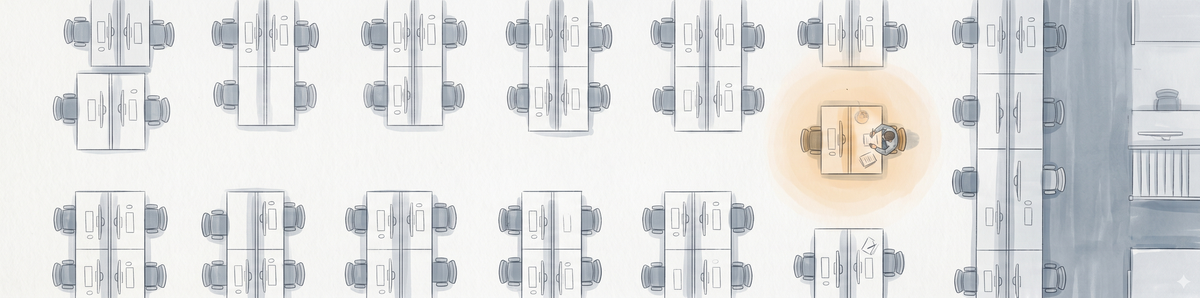
What makes this hard to see is that the symptoms feel personal. People feel overwhelmed. They feel they cannot focus. They feel guilty for not answering fast enough. And so the solutions they reach for are also personal: inbox zero, focus apps, time blocking, meditation, more vacation. All of those help individually. None of them fix what is broken structurally.
Why discipline will not save us
This is where Seth Godin's The Practice matters. Godin's argument is that consistent creative work, the kind that compounds, requires conditions. It requires a daily practice, but the practice cannot happen in a vacuum. It needs protected time, protected attention, and a structure that allows the practitioner to show up and do the work. Godin is writing to individuals, but the implication for organisations is unmistakable. If your work requires people to think, write, design, decide, or build, you cannot expect them to do that work well if every fifteen minutes someone is allowed to interrupt them with a question that could have waited.
We have, collectively, been trying to solve a conditions problem with motivation. We tell people to be more disciplined. We tell them to set boundaries. We tell them to find their own focus time. We tell them to manage their notifications. And then we send them seventy emails in a day and expect them to keep up. The framing is convenient, because it locates the problem in the person rather than in the system. But it is wrong. As Godin puts it, the practice is what the professional shows up for. The conditions are what the organisation owes the professional.
Oliver Burkeman, in Four Thousand Weeks, makes this even more uncomfortable. Burkeman's argument is that busyness is a defence mechanism. It is, often, easier to be busy than to choose what to actually do. The infinite inbox is a generous supplier of legitimate looking work, and engaging with all of it lets us avoid the much harder act of deciding what matters and committing to it. An organisation that lets its hive mind run unchecked is, by default, choosing not to choose. It is letting the loudest message, the latest ping, the most insistent sender determine the next minute of attention. That is not strategy. That is drift, dressed up as activity.
A case in point
I had a meeting recently that captured this perfectly. The agenda was nominally about a regulatory deadline, but the first twenty minutes were spent reconstructing what had been agreed across about forty earlier messages spread over three channels and two email threads. Nobody had the full picture. Everyone had a fragment. Once we stopped trying to reassemble the past in writing and started talking, we resolved the substance in another half hour. The total cost of that meeting was not the ninety minutes on calendars. It was the three weeks of asynchronous noise that preceded it, during which everyone involved had been partially distracted, partially informed, and entirely unable to move the file forward. That cost is invisible on any dashboard. It is very visible in the quality of the work.
What I take from meetings like that one, every time I have one, is that we already know how to work together. We know how to talk to each other. We know how to scope a problem, divide it up, and agree on what comes next. What we have lost is the institutional permission to do that as the default, instead of as a last resort when the hive mind has burned through enough goodwill that someone finally calls a meeting.
What leaders actually have to decide
If the diagnosis is structural, the fix has to be structural too. Personal productivity advice cannot reach a problem at this layer. Only leadership can. And leadership, in this context, is not about giving a speech on focus. It is about making concrete decisions that change how the organisation coordinates. There are four of those decisions that matter most, and they belong on the agenda of any executive committee that is serious about this.
First, decide which channel carries which traffic. Email is not chat. Chat is not project management. Project management is not the source of truth for decisions. When every channel can carry every kind of message, every channel demands constant attention. When channels have clear roles, attention can be allocated deliberately.
Second, decide what response times actually are, by channel, in writing. If a chat message is not expected to be answered within the hour, say so. If an email gets a one business day window, say so. Norms that everyone is half guessing at are not norms. They are anxiety.
Third, decide what counts as an interruption. Not every colleague has the right to pull any other colleague out of focused work at any time. Some do. Most do not. Making that explicit is uncomfortable. Leaving it implicit is more expensive.
Fourth, decide what the default meeting cadence is, and what is reserved for synchronous time. Newport's argument here is one I keep coming back to, synchronous communication, used at the right moments, is not the enemy of focused work. It is what protects focused work from being eaten alive by asynchronous noise. A short, well prepared meeting that actually resolves the issue is a gift to everyone's calendar that week.
These are not productivity tweaks. They are decisions about how the institution coordinates. They cannot be delegated downward, because they are governance choices about who gets to demand attention from whom, and under what conditions. When leadership refuses to make those choices, the default takes over. The default is the hive mind.
A short European note
There is a Belgian and European angle that I do not want to oversell, but it is worth naming. The right to disconnect, embedded in Belgian federal law since 2022, is a recognition that asynchronous overflow has reached a point where individuals can no longer defend themselves alone. That is a useful legal baseline. But, as Newport warns about the earlier French version, regulation that targets after hours email misses the bigger point. The problem is not only that we email at night. It is that we communicate this way at all, all day, as the default. The right to disconnect from a broken workflow is much less valuable than a working workflow.
What the organisation forfeits if it does not choose
The stakes here are not soft. An organisation that does not actively design its coordination model forfeits three things, in order. First, it forfeits the kind of work that requires sustained attention, strategy, complex analysis, real writing, careful design, considered judgement. Second, it forfeits the people who came to do that kind of work and who eventually realise they cannot do it here. Third, and this one takes longer to see, it forfeits the ability to execute on its own ambitions, because every meaningful initiative requires the depth that the hive mind has quietly eroded. By the time the symptoms reach the executive committee, in the form of missed targets, quiet departures, and a slow loss of edge, the cause has been compounding for years.
Burkeman would say, and I think he would be right, that the hardest part of all of this is the choosing. Most leadership teams are perfectly capable of designing a better coordination model. What stops them is that doing so means deciding what the organisation will not do, will not answer, will not interrupt, will not chase. That is a harder conversation than buying another collaboration tool. It is also the only one that actually moves the problem.
The hyperactive hive mind is not a personal failing of overwhelmed employees. It is the visible surface of an organisational design choice that no one made on purpose. Naming it that way is the first step. Acting on it is the second. Both are leadership work.
Sources and methods
Newport, Cal. A World Without Email: Reimagining Work in an Age of Communication Overload. Portfolio, 2021. The book provides the structural diagnosis of the hyperactive hive mind and the case for designing coordination protocols deliberately.
Godin, Seth. The Practice: Shipping Creative Work. Portfolio, 2020. Establishes that creative output is a function of protected conditions rather than motivation, which makes those conditions an organisational responsibility.
Burkeman, Oliver. Four Thousand Weeks: Time Management for Mortals. Farrar, Straus and Giroux, 2021. Argues that busyness is a defence against the harder work of choosing what matters, which is precisely what leaders avoid when they tolerate the hive mind.
Earlier post on this blog, "Why better leadership will not save us (yet)", April 2021, available at evilplanforworlddomination.com. The present article extends that argument with the addition of Godin and Burkeman.