It is not the gap, it is the floor we fear most
Belgium is growing more equal, and still the unions march. Perhaps it is not the gap people fear, but the floor.

This is weekend reading, so it is a bit longer than usual. The subject warrants it.
On Monday 2 November, at half past nine, Bart De Wever went to the palace to offer his resignation. His five parties could not agree on a budget. The king held the offer under consideration and sent him back to the table. De Wever reports again on 16 November. A week later, on 23 November, the three big unions march through Brussels once more.
Here is what puzzles me. By the measures economists use, Belgium is becoming more equal. At the end of 2010 the richest tenth of Belgian households held 59.4 per cent of household wealth. In the first quarter of this year it was 54.4 per cent. The poorest half went from 6.8 to 7.7 per cent. Income tells the same story. For Belgium, Eurostat’s Gini coefficient, the standard measure of income inequality, fell from 25.9 in 2014 to 23.4 in its latest release.
Across the ocean the picture is the other way round. The richest 1 per cent of Americans now hold 32.5 per cent of household wealth. That is the highest share since the Federal Reserve’s series began in 1989. The poorest half holds 2.3 per cent. Yet median household income reached 87,460 dollars in 2025, “the highest on record dating back to 1967”, according to the Census Bureau.
So the country that grows more equal is the one on strike.
The audience
My last piece was about the clowns that come out when politics becomes entertainment. Near the end it turned to the audience, because a show needs one, and that is us. This time I want to look at the audience itself. How are we looking at the stage, and in what mood did we come in?
The starting idea
My first idea was simple. Our societies grow richer, but the gap between the top and the rest grows faster. So a richer society ends up with more people who feel left out. Now add a social security system that is being trimmed. Add foreign actors who fan hatred to destabilise Europe and the United States. Add the monkey mind we all have, with a phone in its pocket, clicking on anger before anything else. You get a dangerous mix. Politicians are not equipped to handle it, because the system keeps the people who fan the flames and loses the people who do the work.
I suspected I might be wrong, so I went looking. I was partly wrong, and the part I got wrong turned out to be the interesting one.
Two gaps
In the United States my thesis holds. The share of the top 1 per cent went from 22.8 per cent in 1989 to 32.5 per cent today. Over the same years the share of the poorest half fell from 3.5 to 2.3 per cent. The country got richer and the top pulled away.
In Europe it does not hold. Across the European Union the Gini coefficient fell from 30.9 in 2014 to 29.2 in the latest release. In the euro area the richest tenth has held about 57 per cent of household wealth since 2014. And in Belgium, as we saw, the gap is narrowing.
In America the gap grows. In Belgium it shrinks, but judging by the strikes, the anger grows anyway.
So the size of the gap cannot be the whole story. If that were the case, Belgians would be the calmest people in Europe.
The floor
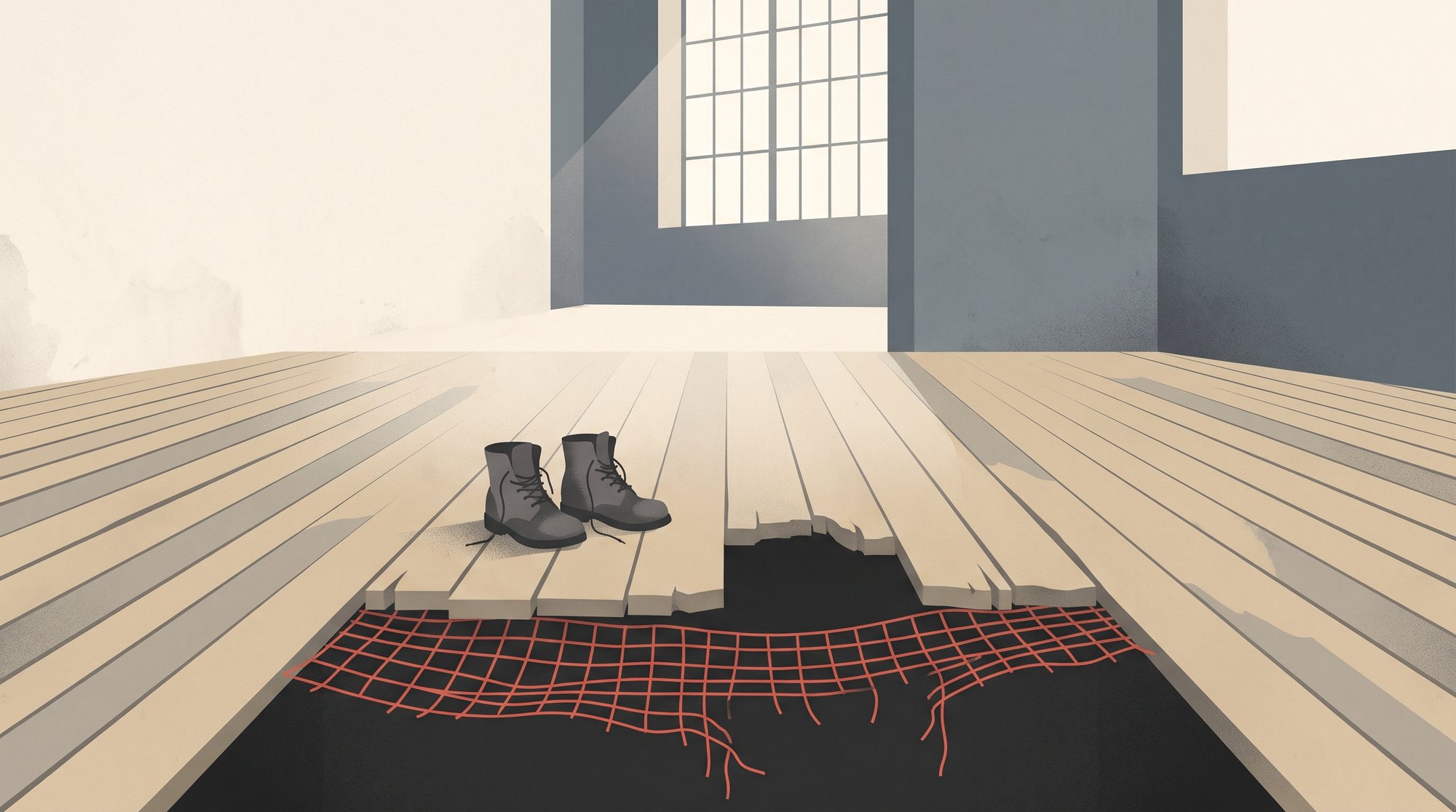
What the two countries share is not the gap. It is a promise wearing thin. America had the American Dream, the ideal that anyone can rise from rags to riches. Belgium had the promise that society would catch you, a floor you would not fall through. Both, I would argue, turn out to be less realistic than most people thought.
On the night of 28 to 29 May the Chamber passed the pension reform of the De Wever government. Anyone who retires early will get a reduced pension, unless they worked 35 years of at least 156 days a year. A total of 7,020 days also counts. The same night it limited two rounds of indexation, the automatic link between wages and prices. Wages are indexed only up to 4,000 euros gross a month, and benefits and pensions up to 2,000. The pension reform takes effect in 2027, and the unions plan to take it to the Constitutional Court this autumn.
Unemployment benefits are now limited to a maximum of 24 months. Until this year some people had drawn them for more than 20 years. The right ends in waves, and the first, on 1 January 2026, included those who had been unemployed the longest. In the first three months, 45,591 people lost their benefits. A little over 4,200 of them found work, fewer than one in ten. These were people who had been out of work for at least 8 years, in the first wave more than 20. A quick return to work was always going to be hard. More than 23,000 ended up on the leefloon, the social assistance paid by the local public welfare centre. More than 4,300 went onto sickness or disability benefits. VRT adds that many others simply dropped out of the statistics, finding no work and claiming no benefit. Yes, that is right. Most of these people did not move into work. They fell one level lower. In September the Constitutional Court ruled that some of them should have kept their benefits for at least 12 months, not 6 to 9. Their end dates are now being recalculated.
In the United States the dream has shrunk to something more basic, health cover. The Congressional Budget Office expects the budget law of 2025 to leave 10 million more Americans uninsured in 2034. For 7.5 million of them, the cause is cuts to Medicaid. The health policy research organisation KFF reports that estimate.
Is the fear real, or am I projecting it? The OECD measured it in its Risks that Matter survey of 2022. Among Belgians aged 18 to 64, 71 per cent worried about their financial security in old age, and 63 per cent about making ends meet. Both figures were below the average of the countries surveyed, and they date from before the reforms. In a poll for the European Parliament in November 2025, 40 per cent of Belgians expected their standard of living to decline. Only France was higher, and Slovakia was level with Belgium. So I would not claim Belgians are the most anxious people in Europe. I would claim the fear is rising.
Position and direction
Research helps explain why a narrowing gap and a growing anger can go together. Brian Burgoon and three colleagues studied what they call positional deprivation, falling behind others. They matched it to party preferences in 20 European countries from 2002 to 2014. Their finding has two halves. Falling behind the growth of the richest tenth “tends to spur support for radical left but not radical right parties”. Falling behind the growth of the poorest tenth “tends to spur support for radical right but not left parties”.
What drives people is where they stand and who they compare themselves with. You can be angry at the people above you. You can also be angry at the people below you, who seem to catch up without paying in. Keep that second kind of anger in mind. I will come back to it, because it gets personal.
The monkey mind
Then there is the stage on which all this plays out. Steve Rathje, Jay Van Bavel and Sander van der Linden analysed 2,730,215 posts on Facebook and Twitter. They came from news media and members of the US Congress. Each word referring to the political out-group “increased the odds of a social media post being shared by 67%”. That effect was about 4.8 times as strong as negative language in general, and 6.7 times as strong as moral and emotional language.
We are not built to scroll calmly past a threat. The platforms know that, and they are paid for our attention. A worry about your pension is quiet. A post about who is to blame for it is not.
The foreign hand
And some of the blame posts are not written by our neighbours. The European External Action Service detected 540 incidents of foreign information manipulation in 2025. It attributed 29 per cent of them to Russia and 6 per cent to China. In her foreword Kaja Kallas writes that “more than a hundred countries were attacked”.
Now, before you get me wrong, I am not waving this away. The operations are real, and they are growing. But look at what they achieve. Gregory Eady and five colleagues linked American survey respondents to their Twitter feeds during the 2016 election. They found that “only 1% of users accounted for 70% of exposures” to the Russian accounts. And they found “no evidence of a meaningful relationship” between that exposure and changes in attitudes, polarisation or voting. Foreign actors pour fuel on a fire they did not light. What they do to trust is harder to measure.
The clowns
Which brings me back to the stage. In my view, the politician who sells anger gets more airtime in a system that rewards attention than the one who looks for a solution. In July I wrote about how a system works exactly as it is designed. An audience that walks in afraid gets the show it is most likely to applaud.
The strongest objection
Now let’s take a look at what is on the table, because these reforms exist for a reason.
Our pensions are not savings we put aside for ourselves. Each generation pays for the one before it. That works as long as there are enough workers behind each pensioner. The Study Committee on Ageing, part of the High Council of Finance, published its yearly report in July. It compares Belgians aged 67 and over with those of working age. In 2025 there were 28.9 older people for every 100 of working age. In 2070 there will be 42.4. Social spending rises from 25.7 to 27.2 per cent of GDP. That is with the pension reform included, which according to the committee lowers the cost of pensions by 1.4 percentage points of GDP. If productivity grows by 0.9 per cent a year instead of 1.1, the cost of ageing more than doubles. The generation that now retires paid for its parents and contributed a great deal. There are fewer of us behind them.
And I catch myself asking a harder question. Were we too generous in the past? As I see it, for decades Belgium accepted large groups of people who were structurally unemployed, some of them for more than 20 years. The limit of two years is the correction. Many of them are now finding out how low the floor really is.
Yes, that question is fair. But notice where it looks. It looks down the ladder, at the people who seem to receive without paying in. That is exactly the comparison Burgoon and his colleagues link to the radical right. I feel it too, and I consciously correct for it, because that is not where I stand. And the fairness argument runs in both directions, because the generation we now pay for also received rules the next one will not get.
So some adjustment is needed. The question is who will carry it, and whether the rules stay stable enough to plan a life on.
The recalibration
That is also where the government split. According to the public broadcaster VRT, three parties want more effort from the “sterkste schouders”, the broadest shoulders. They are Vooruit, Les Engagés and CD&V. For the liberals of MR, David Clarinval complains of “te veel belastingen”, too many taxes. The budget crisis is this question, asked at a table of five.
So here is my own view. I see four things a recalibration has to do, whatever the instruments. There are no easy solutions left. And none of the four works overnight. Whatever we choose will take years before people feel it in their wallets, so the sooner we start, the better.
The floor and work
The first is a floor that is there for everyone, and that is explicit and stable. People can live with a lower promise more easily than with a promise that changes every budget round. Tell people what they can count on, adjust it rarely, and announce every change well in advance.
But it has to be a floor of the kind where working always pays, whatever the work is. There are two ways to widen the gap between work and no work. You can lower what people get without work, or you can raise what they keep from work. The limit on unemployment benefits does the first, and we saw where most of those people landed. Far more went onto the leefloon than into a job. I think we should re-examine that, because it pushes people into a poverty trap. Belgium also has a tool for the second. The werkbonus lowers the social contributions on low wages. According to the National Social Security Office, the RSZ, it aims to “werknemers met een laag loon een hoger nettoloon te garanderen”. That means a higher net wage for workers on a low wage. It fully offsets the worker’s contribution up to a wage of about 2,300 euros gross a month. If we want work to pay, that is the lever to pull harder, instead of pushing the floor lower.
Growth built to last
The second is the option I hear least about. Instead of only braking, we could accelerate in the descent, so that we take flight before we hit the ground. In plain words: invest now, so that the economy grows before the bill of ageing arrives.
The committee’s own figures show it. With productivity growth of 1.1 per cent a year, the cost of ageing is 1.5 percentage points of GDP. With 0.9 per cent, it is 3.3. Two tenths of a percentage point of growth a year more than halves the problem.
Perhaps this is controversial, but I think a government should actively invest in giving its new businesses every chance to grow. Growth can also widen the gap, though. So I would rather support the businesses that have a long term vision and let their employees participate. In my experience, growth designed around a quick exit tends to reward a few people very well after six to eight years of hard work. I do not begrudge them that. But growth built to last is good for the people who work there, and for the country.
Belgium already has more of the toolkit than people think. Under a collective agreement known as CAO 90, a company can pay its staff a bonus tied to its collective results. In 2026 it is tax free up to 3,701 euros net. A profit bonus has existed since 2018, and participation plans in a company’s capital and profits since a law of 22 May 2001. SD Worx payroll data show that nearly one employee in five got a results bonus in 2024. The profit bonus is rarer. Only 2.14 per cent of employers paid one. The Belgian Cooperative Monitor counts 24,971 active cooperatives in 2016 and 12,517 in 2025. Part of that drop came from cooperatives choosing another legal form after the 2019 company code. Only 1,702 have adopted the new cooperative status of the 2019 company code. Of those, 485 are accredited by the National Council for Cooperation.
Other countries show how far this can go:
- In the United Kingdom, a law of 2014 let owners sell their company to an employee ownership trust without capital gains tax. The country now counts 2,824 employee owned businesses with 547,971 employee owners, according to the Employee Ownership Association. Since 26 November 2025 only half of that relief applies. A government can steer, and it can also take its foot off the pedal.
- In the United States, the National Center for Employee Ownership counts 6,609 employee stock ownership plans, with 15.1 million participants. In such a plan, a trust holds company shares for the staff.
- In France, profit sharing is compulsory from 50 employees. The official guidance reads “La participation est obligatoire dans les entreprises qui emploient au minimum 50 salariés”.
- In Germany, companies with more than 2,000 employees must give half the seats on their supervisory board, the body that oversees management, to employees. In a count published in June 2024 the Hans Böckler Foundation found that only 656 of 1,084 such companies did so. That is about 60 per cent, down from 67 per cent in 2019. Many of the others use legal loopholes, and some simply ignore the law.
- Then there are companies owned by a foundation. The Robert Bosch Stiftung holds about 94 per cent of the capital of Bosch. The Carlsberg Foundation holds about 76 per cent of the votes in Carlsberg. Novo Holdings holds more than 70 per cent of the votes in Novo Nordisk. In March 2026 two German ministries put forward a discussion proposal for a new legal form for companies with locked-in capital. In their words, it should promote “nachhaltiges, an langfristigen Zielen orientiertes Unternehmertum”, sustainable enterprise aimed at long term goals.
- And there are cooperatives. Mondragon in the Basque Country employed 71,415 people in 2025. The International Cooperative Alliance counts 3 million cooperatives worldwide, providing work to 280 million people.
Does it work? The evidence is modest. Douglas Kruse, Richard Freeman and Joseph Blasi concluded that “workers can gain by sharing”, but also that sharing works badly together with close supervision. E. Han Kim and Paige Ouimet found that some large employee share plans raise productivity and pay, but “the average impacts are small”. Fidan Ana Kurtulus and Douglas Kruse found that employee owned firms in the United States “exhibit greater employment stability”. In Uruguay, Gabriel Burdín found that the risk of closing is 24 to 38 per cent lower for firms run by their workers. On board seats the evidence is more mixed. In Germany, Simon Jäger, Benjamin Schoefer and Jörg Heining found “no effects of board-level codetermination on wages”. An older meta-analysis by Chris Doucouliagos found that profit sharing and worker ownership go with higher productivity, and codetermination laws with lower.
There is also a real risk. Lisa Meulbroek looked at employees who hold a quarter of their pension savings in shares of their own employer. Because they cannot spread the risk, they “sacrifice 42 percent of the stock’s market value”. Participation should never mean putting your job and your savings in the same basket.
So the case for participation is not faster growth. It is growth that is shared, and jobs that are steadier. That is what a floor needs. We have the instruments. As far as I can find, none of our public investment companies uses employee participation as a criterion. Only finance&invest.brussels has a line for social economy projects. We could actually become an example. But for that, the government has to invest structurally in this kind of growth.
The broadest shoulders
The third is an adjustment that is fair to everyone who contributes. People contribute through work, through taxes on capital as well as on labour, and through care that shows up in no payroll. If the broadest shoulders carry less than the narrowest ones, the floor will not hold, because nobody will believe in it.
How the broadest shoulders carry their share matters as much as how much they carry. They need to believe that a government can deliver on its promise, rather than simply collect more money for the way things are done today. If they do not, they may leave, and I would not blame them. There are policy instruments that let employers support their employees directly, beyond payroll. I wrote about them on 30 October. There should also be instruments that let employers support people other than their own staff, with an advantage in return. In my view, the government is not today the most efficient and effective route for every euro.
Daylight
The fourth is that changes to the floor are made in daylight. In my last piece I proposed a citizens’ council drawn by lot, starting with party funding. The floor would be a good second subject. I would argue that the people who stand on it are the least represented at the table where it is redrawn.
The people who will march on 23 November need this. So do the ones who will stay at home, worried.
Think about it.
Sources and Methods
Translations from Dutch, French and German are mine. All figures were checked against the sources below on 7 November 2026. Where a primary source could not be reached, the secondary source is named.
Data
- Federal Reserve, Distributional Financial Accounts, via FRED: share of net worth held by the top 1 per cent and by the bottom 50 per cent.
- U.S. Census Bureau, Income in the United States: 2025 (2026).
- Eurostat, Gini coefficient of equivalised disposable income, release of 6 November 2026. The survey year 2025 mostly measures incomes of 2024.
- European Central Bank, Distributional Wealth Accounts, shares of net wealth for Belgium and the euro area.
- OECD, Risks that Matter Survey 2022, Belgium (2023).
- Hoge Raad van Financiën, Studiecommissie voor de Vergrijzing, Jaarlijks verslag (July 2026).
- RVA, Hervorming van de werkloosheidsverzekering, third monitoring of outflow and the ruling of the Constitutional Court (2026).
- Congressional Budget Office estimate of the coverage effects of the 2025 reconciliation law, as reported by KFF, How Will the 2025 Reconciliation Law Affect the Uninsured Rate in Each State? (2025). The CBO page itself was not reachable.
- SD Worx payroll data on results bonuses and profit bonuses in 2024, as reported by Forum for the Future. Secondary source; no official take-up figures were found.
- Buyssens Advocaten via Jubel, on employee participation in capital and profits and the profit bonus (2019). Secondary source for the law of 22 May 2001 and the profit bonus of 2018.
- FOD Werkgelegenheid, Niet-recurrente resultaatsgebonden voordelen.
- RSZ, administrative instructions on the werkbonus.
- KCO, Belgian Cooperative Monitor 2016 to 2025 (2026).
- Employee Ownership Association, sector count from the register of March 2026 and statement on the change in capital gains tax relief; Finance Act 2014, Schedule 37.
- National Center for Employee Ownership, Employee Ownership by the Numbers (January 2026).
- Code du travail numérique, Participation.
- Mitbestimmungsgesetz (1976) and Hans-Böckler-Stiftung, press release of 12 June 2024.
- Bosch, Carlsberg Foundation and Novo Holdings on their ownership.
- KPMG Germany, on the discussion proposal of the German ministries of justice and finance (March 2026), reproducing their press release.
- International Cooperative Alliance, Facts and figures, and Co-operative News, on Mondragon in 2025 (2026).
- Brussels Region, finance&invest.brussels.
Studies
- Brian Burgoon, Sam van Noort, Matthijs Rooduijn and Geoffrey Underhill, “Positional deprivation and support for radical right and radical left parties”, Economic Policy 34 (97), 2019. Quoted from the abstract.
- Steve Rathje, Jay Van Bavel and Sander van der Linden, “Out-group animosity drives engagement on social media”, PNAS, 2021.
- Gregory Eady, Tom Paskhalis, Jan Zilinsky, Richard Bonneau, Jonathan Nagler and Joshua Tucker, “Exposure to the Russian Internet Research Agency foreign influence campaign on Twitter in the 2016 US election and its relationship to attitudes and voting behavior”, Nature Communications, 2023.
- European External Action Service, 4th EEAS Report on Foreign Information Manipulation and Interference Threats (March 2026).
- Douglas Kruse, Richard Freeman and Joseph Blasi, “Do Workers Gain by Sharing? Employee Outcomes under Employee Ownership, Profit Sharing, and Broad-based Stock Options”, NBER Working Paper 14233 (2008).
- E. Han Kim and Paige Ouimet, “Broad-Based Employee Stock Ownership: Motives and Outcomes”, Journal of Finance (2014).
- Fidan Ana Kurtulus and Douglas Kruse, “An Empirical Analysis of the Relationship between Employee Ownership and Employment Stability in the US: 1999–2011”, British Journal of Industrial Relations (2018).
- Gabriel Burdín, “Does workers’ control affect firm survival? Evidence from Uruguay”, University of Siena working paper (2012).
- Simon Jäger, Benjamin Schoefer and Jörg Heining, “Labor in the Boardroom”, Quarterly Journal of Economics (2021).
- Chris Doucouliagos, “Worker Participation and Productivity in Labor-Managed and Participatory Capitalist Firms: A Meta-Analysis”, ILR Review (1995).
- Lisa Meulbroek, “Company Stock in Pension Plans: How Costly Is It?”, Journal of Law and Economics (2005).
Reporting
- VRT NWS, on the failed budget talks (2 November 2026) and on the demonstration of 23 November (21 October 2026).
- Nederlands Dagblad, on the king’s decision (6 November 2026).
- VRT NWS, on the pension reform, and RTBF, on the vote in the Chamber (29 May 2026).
- VRT NWS, on the first three months of the limit on unemployment benefits (26 June 2026), based on RVA figures.
- The Brussels Times with Belga, on the European Parliament poll (4 February 2026). The Parliament’s own publication was not found.