When politics becomes entertainment, expect the clowns to come out
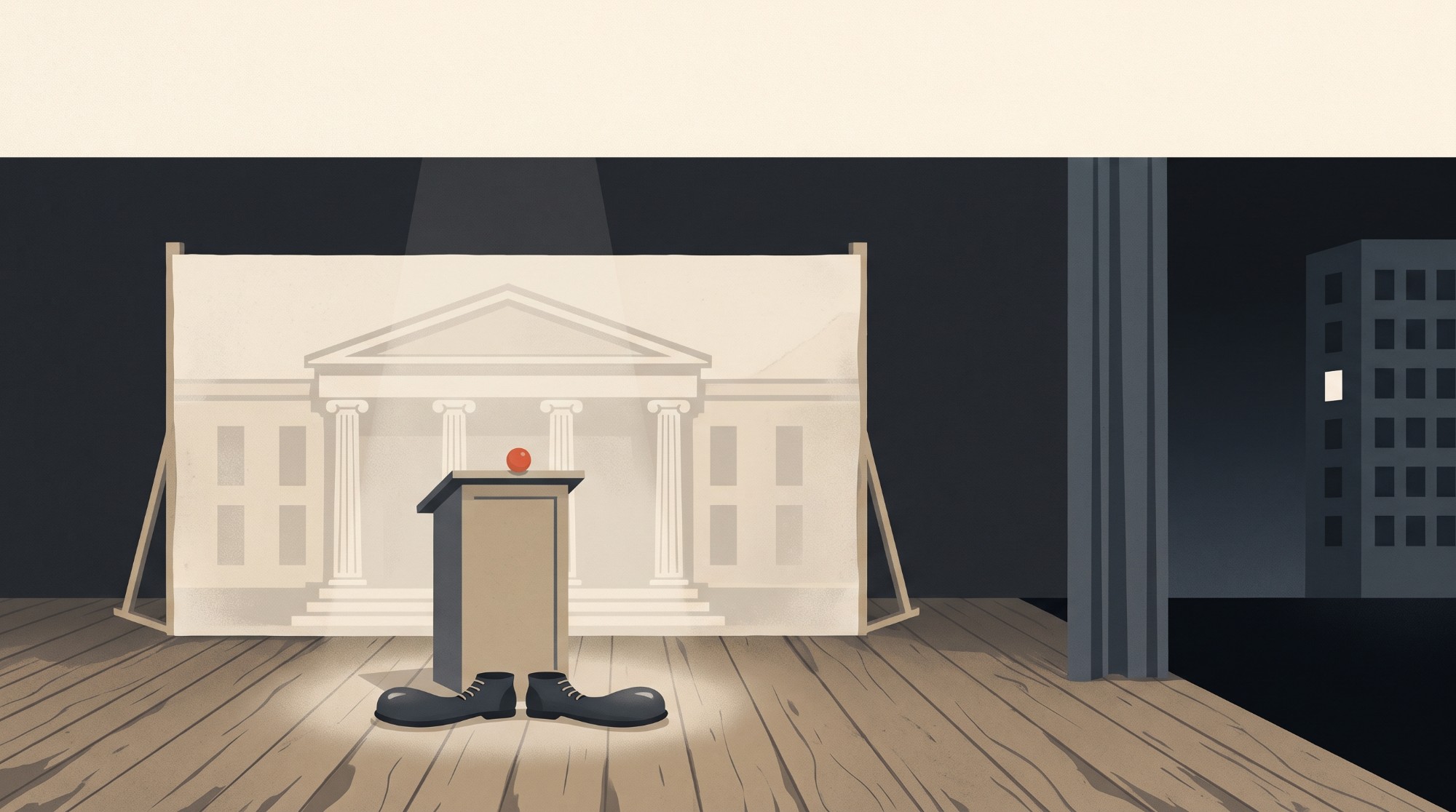
A clown is an exaggeration of a person. That is what I see in a lot of politics today, in the United States and in Belgium, and the system rewards it.

“I have built my staff around comms rather than legislation,” wrote Madison Cawthorn in January 2021. The American congressman sent that line to his Republican colleagues, in an email obtained by TIME. Comms means communications. A man elected to help write laws was telling his colleagues that laws were not the focus.
But was the claim true? LegiStorm did the counting. Going by job titles, a quarter of his staff worked on policy and 12 percent on communications. That is roughly the average for a House office. The boast was the show.
When politics becomes entertainment, expect the clowns to come out. I want to be careful with that word, though. A clown is an exaggeration of a person. You still recognise the human being under the big shoes and the painted smile, but everything is turned up for the back row. That is what I see in a lot of politics today, an exaggeration of the person we expected to find there.
A side note. I work in public affairs at Pluxee. Part of my job is to talk to politicians and their cabinets about rules that touch our business. These are my own views, not Pluxee’s. I am not going to convince anyone that I am neutral, but I am informed. And I assume good faith in most of the people involved. This piece is about the system that surrounds them.
The attention hack
In July I wrote here that your dysfunctional organisation is working exactly as designed. David Peter Stroh’s point in Systems Thinking for Social Change is that systems are perfectly designed to achieve the results they are achieving. Apply that to a parliament and the clowns stop being a mystery.
Bruce Schneier supplies the other half in A Hacker’s Mind. A hack, he writes, is “an activity allowed by the system that subverts the goal or intent of the system.” Representative democracy has a goal. We cannot all sit in one room, so we send someone to speak for us, listen to the other side and strike a deal. But the rules do not require any of that. The rules only require you to get elected. If attention wins elections more reliably than work does, then attention is what the system will select for. That last step is my own reading.
None of this is new. In 1985 Neil Postman argued in Amusing Ourselves to Death that politics had become one of the “congenial adjuncts of show business”. In 2001 the Belgian political scientist Marc Hooghe wrote that new politicians were no longer picked from the study departments or the meeting rooms. They came “van voor de televisiecamera’s”, from in front of the television cameras. The current American president hosted fourteen seasons of The Apprentice.
The signs
If a clown is an exaggeration of a person, you should be able to spot one. I see four signs.
The first is the outburst that pays. In 2009 Joe Wilson shouted “You lie!” at Barack Obama during a joint session of Congress. His campaign then reported 2.7 million dollars for the quarter.
The second is the applause meter. Pew went through 108,235 Facebook posts by members of Congress. Indignant posts averaged 468 likes, posts about bipartisan work 166.
The third is the costume, and in Belgium that is no metaphor. In 2022 Conner Rousseau, then chair of Vooruit, did seven episodes of The Masked Singer dressed as a rabbit. “I am an ordinary guy of 29 who also wants to do something else for once, next to my job,” he told his critics. Bart De Wever got there first, without the costume. VRT says he cashed in a television quiz at the polls. He is now our prime minister, so the show does not rule out the work.
The fourth is the personal channel. In 2024 the Meta ads of Vlaams Belang chair Tom Van Grieken cost 624,000 euro, against 1 million for the party itself. On the left, Jos D’Haese of PVDA was by then the most popular politician on TikTok, with 170,000 followers.
My complaint holds three claims. Representatives do not resemble the people they represent, they serve their backers first, and they have lost the ability to compromise. Let me test each on two countries.
Resemblance
On this one, both countries fail. Nicholas Carnes found that working class Americans made up between 50 and 60 percent of the country over the last hundred years. In each Congress they were 2 percent or less of legislators.
In Diploma Democracy, Mark Bovens and Anchrit Wille report that almost 90 percent of members of parliament in six countries, Belgium included, have higher education. People with low and medium education are up to 70 percent of most of those electorates.
People notice. In this year’s De Stemming survey, Belgians were asked which politician best represents them. The most common answer in all three regions was nobody. That was 38 percent, six points more than a year earlier. In Flanders, De Wever matched it at 30 percent.
Backers
In the United States, backers means money. In this midterm cycle, outside groups spent a record 2 billion dollars by the end of September, by the Brennan Center’s count. One donor, Elon Musk, spent at least 474 million dollars, by CNBC’s count.
In 2014 Martin Gilens and Benjamin Page concluded that average citizens “have little or no independent influence” on policy. This May Peter Enns disputed their method. So the study is contested, while the size of the cheques is not.
Belgium does not work like this. Under the law of 4 July 1989, only individuals may give money to a party, at most 500 euro a year to any one recipient. In 2024 direct public subsidies gave them 83.7 million euro, or 77 percent of their income, according to a University of Leuven study.
So who is the Belgian backer? I would say the party itself. Parties draw up the lists, so I expect the first loyalty of a Belgian politician to run to the party that holds the list.
Parties spend on the show too. In the 2024 election year Belgian politics spent a record 15 million euro including VAT on Meta and Google. In 2023 a citizens’ panel of 60 people chosen by lot made 34 recommendations on party funding, including a yearly cap on social media advertising. In February 2024 the coalition could agree on 13 of the 34. Since the election, subsidies have been cut, but I see no cap on social media spending yet. In America the sponsor sits in the front row. In Belgium you pay for the ticket, and someone else gets the seat.
Interests just find another door. Georges-Louis Bouchez chairs the French-speaking liberals, chairs the football club Francs Borains and sits on the board of the Pro League. On 2 November vice-premier Maxime Prévot of Les Engagés said Francs Borains was blocking a 70 million euro cut in footballers’ advantages. Bouchez did not answer VRT. I see no sign of money changing hands. I see a chair inside the room.
The middenstand
“De middenstand regeert het land,” Gorki sang in Mia. The shopkeepers and small business owners rule the country. Do they?
They certainly carry it. Small and medium companies provide 57.7 percent of the jobs in firms registered with social security.
They also have chairs at the table. In the Group of Ten, where employers and unions negotiate, the small business federations Unizo and UCM hold two of the five employer seats.
Having a chair is something other than ruling, though. In April the Group of Ten, Unizo included, agreed an alternative to the government’s centenindex, a limit on indexing higher wages. The government set it aside, mainly for budget reasons. Pluxee employs someone like me to follow what governments plan. The baker on the corner has a federation and an evening with the paperwork. So my answer to Gorki is that the middenstand is represented, but does not rule.
Compromise
In the United States this claim holds well. Unite America, a group that campaigns for open primaries, calculated in October 2024 that 380 of the 435 seats were decided in party primaries. So for most members, the election that counts is the one inside their own party. I would expect that to reward refusing over bargaining. Last year Washington gave us its longest full shutdown, 43 days, until eight Democrats backed a deal.
In Belgium my thesis breaks. A Belgian politician who refuses every compromise does not govern. De Wever’s federal coalition of five parties took 239 days to form. Brussels needed 613 days and seven parties. For months Ahmed Laaouej’s French-speaking socialists refused to join the talks over De Wever’s N-VA. In June 2025 L’Avenir reported that most negotiators saw the conduct of Bouchez as an obstacle. He later convened the three-day marathon that produced the deal. Both ended in an agreement.
So Belgian party chairs can still compromise, and their representatives follow. What they struggle with is doing it in public. In 2001 Hooghe already described compromises worked out at night summits. All day you watch a performance of a party that will never give in. Then a deal appears after midnight, and it looks like betrayal. That link is my own inference.
In September minister Hilde Crevits and a Vooruit chief of staff became unwell during overnight Flemish budget talks. So why at night? The answer may be simple: fewer eyes on screens. Former minister-president Kris Peeters points first to long bilateral talks. But send everyone home, he says, and they can inform the media and the party base, and the reactions mean one step forward, two back. A deal at 5 in the morning also sells better to the base than one at 5 in the afternoon. One negotiation expert calls that “the showbizz of politics”.
The American clown never takes off the make-up. The Belgian one takes it off at midnight and hopes nobody is looking.
The strongest objection
Now, before you get me wrong, I know this argument has a weak spot. Politics has always been theatre, and representatives have never looked much like the people. Perhaps there was never a golden age, and I am just complaining about the present.
Yes, partly. And voters are not helpless. Cawthorn lost his primary after one term. On 3 November American voters handed both chambers of Congress to the Democrats, whatever Musk’s millions were meant to buy.
But an election changes the cast and leaves the format in place. What I think has changed is the balance of rewards. The theatre used to be something you did on the way to the work. For some politicians, it has become the work.
The audience
Which brings me in a roundabout way to the uncomfortable part. A show needs an audience, and that is us.
In 2020 I wrote here about overvaluing authenticity, which I said is often “the excuse for doing anything without holding back”. That is the clown’s sales pitch. At least he says what he thinks.
Start with a posture. Stop paying for the show with your attention. When a politician strikes a deal and takes the heat for it, say so out loud. Ask what someone passed and who they had to convince, and care less about who they destroyed on television.
The make-up
So how do we take it off? We do not have to go far. Since 2019 the German-speaking Community has had a permanent citizens’ council drawn by lot. It picks topics and convenes assemblies, also drawn by lot. Parliament must justify any rejection. It is small, advisory and still learning. But nobody in that room needs re-election, a list place or a clip. And the baker has the same chance of a seat as the lawyer.
Keep parliament. Add such a council at federal level, start with party funding, where 60 citizens already did the homework, and make parliament answer in public. Then at least part of the deal has to happen in daylight.
Our parliaments need this. So do the 38 percent who answered nobody.
Sources and Methods
Translations from Dutch are mine.
Books
- Neil Postman, Amusing Ourselves to Death (1985).
- Bruce Schneier, A Hacker’s Mind (2023).
- David Peter Stroh, Systems Thinking for Social Change (2015).
- Mark Bovens and Anchrit Wille, Diploma Democracy (2017), summarised by the authors on the LSE Europp blog.
Song
- Gorki, Mia.
Studies and data
- Nicholas Carnes, “Does the Numerical Underrepresentation of the Working Class in Congress Matter?”, Legislative Studies Quarterly (2012).
- Martin Gilens and Benjamin Page, “Testing Theories of American Politics”, Perspectives on Politics (2014).
- Peter Enns, “How a Seemingly Innocuous and Intuitive Methodological Choice Confused a Generation of Research on Policy Responsiveness”, Sociological Science (2026), reported by Cornell University.
- Marc Hooghe, “De nachtwacht van de democratie”, Ons Erfdeel (2001).
- Pew Research Center, Partisan Conflict and Congressional Outreach (2017).
- Christoph Niessen and Min Reuchamps, “Institutionalising Citizen Deliberation in Parliament”, Parliamentary Affairs (2020).
- UCLouvain team, “The Ostbelgien Model: five years on”.
- G1000, Permanent Citizen Dialogue in Ostbelgien.
- We Need To Talk, Burgerpanel over partijfinanciering (2023).
Law
- Wet van 4 juli 1989 on electoral expenses and party finance, article 16bis, Justel.
Reporting
- TIME, Madison Cawthorn profile (2021).
- LegiStorm, analysis of Cawthorn’s staff (2021).
- Brennan Center for Justice, midterm spending analysis (2026).
- IVN, on Unite America’s primary analysis (2024).
- Forum for the Future, figures on Belgian small and medium companies (2025).
- CBS News, end of the 2025 shutdown (2025).
- CNBC, 2026 midterm results (2026).
- VRT NWS, portraits of Conner Rousseau (2023) and Bart De Wever (2025).
- VRT NWS, on TikTok and the 2024 campaign (2024) and the Brussels formation (2025).
- VRT NWS, on night work in political negotiations (2025, republished 2026) and Kris Peeters on night talks (2026).
- VRT NWS, on footballers’ advantages and the budget (2026).
- VRT NWS, on De Stemming 2026, party finances (2025) and the AdLens annual report (2025).
- Mehr Demokratie, Belgian citizens’ assembly on party funding (2023, updated after the 2024 election).
- Roll Call, Wilson’s fundraising after the outburst (2009).
- NPR, Cawthorn’s primary defeat (2022).
- L’Avenir, negotiators on Georges-Louis Bouchez (2025).
- Unizo, social partners’ alternative to the centenindex (2026).
- Securex, government decision on the centenindex (2026).
- Brussels Signal, Brussels government after 613 days (2026).
- Wikipedia, 2024 to 2025 Belgian government formation, The Apprentice and Groep van Tien.